
Money is one of the first practical puzzles every visitor to Indonesia has to solve. The currency is the rupiah (IDR, symbol Rp), and prices can look startling at first — a simple coffee might be listed at Rp45,000. Don't panic: at roughly Rp16,000 to US$1, that coffee costs under three dollars. Learn to mentally drop three zeros (Rp50,000 ≈ $3) and Indonesian prices start making sense fast. This guide covers what a first-time visitor needs most: the cash, the cards, the ATMs, and how paying for rentals works.

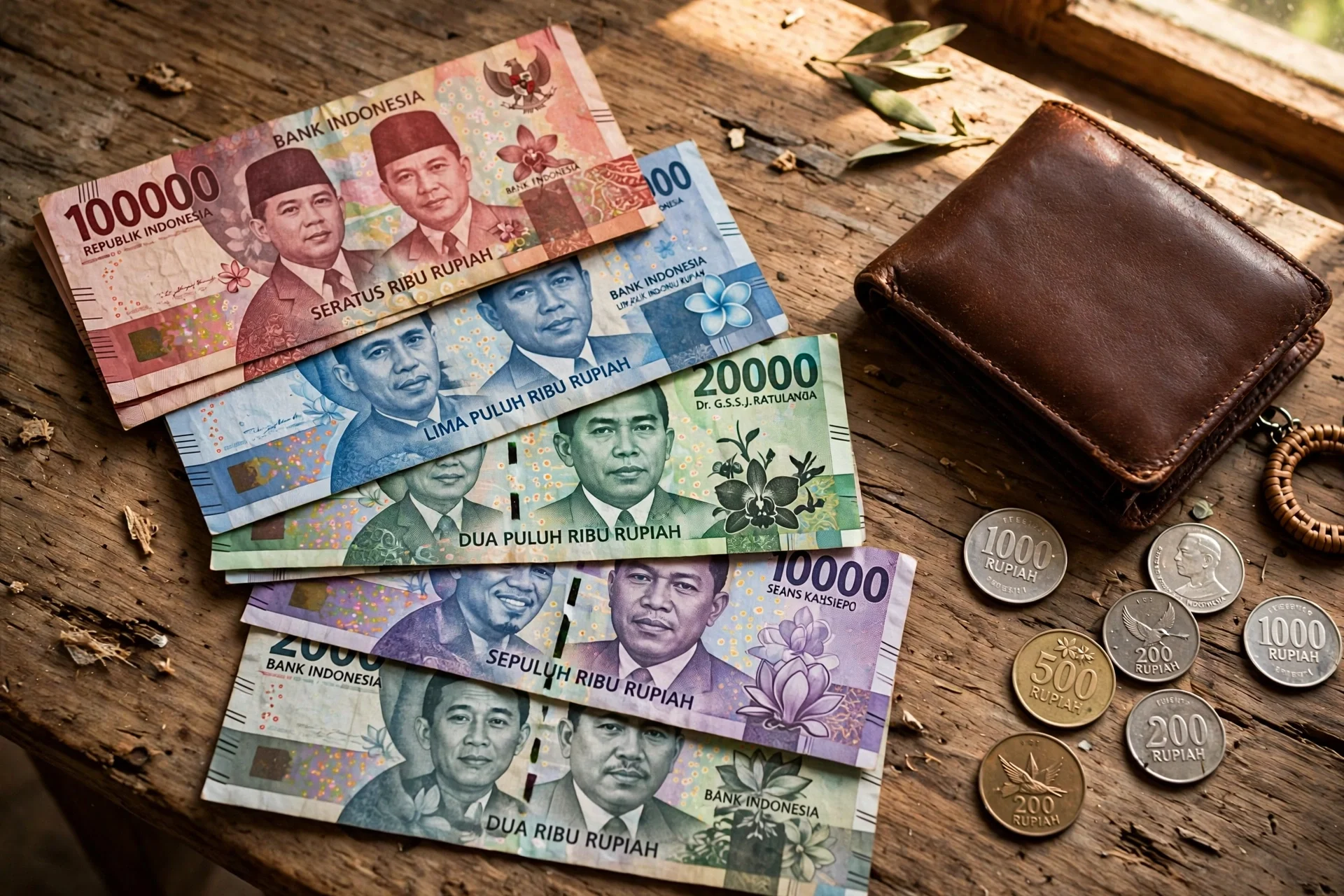
Indonesian rupiah notes — the Rp100,000 note is worth about $6.25.
Know Your Rupiah: Notes and Coins
Indonesian banknotes come in Rp1,000, Rp2,000, Rp5,000, Rp10,000, Rp20,000, Rp50,000, and Rp100,000. The largest note, Rp100,000, is worth only about $6.25 — so you'll handle a lot of paper. Coins exist (Rp100–Rp1,000) but are worth just a few cents each.
Always carry small notes. Street food stalls and small shops often can't break a Rp100,000 note for a Rp15,000 snack. Break big notes at convenience stores like Indomaret or Alfamart — there's one on nearly every block — with a small purchase. One local quirk: people often shorten prices in speech. "Lima puluh" (fifty) usually means Rp50,000. When in doubt, confirm with "Rp50 ribu, ya?" (fifty thousand, right?).
Cash or Card? What Actually Works in Jakarta
Jakarta runs on both. Malls, hotels, chain restaurants, and ride-hailing apps accept international credit and debit cards without fuss. But street vendors, traditional markets, small warung eateries, and many independent shops are cash-only — or accept local QR payments that foreign visitors usually can't set up.
A good rule: carry a day's small spending in cash — roughly Rp300,000–Rp500,000 (about $19–$31) — and use your card for hotels, malls, and larger purchases.

Cash is still king at Jakarta's street stalls and small shops.
ATM Tips for Foreign Cards
ATMs are everywhere — in malls, at bank branches, and inside convenience stores. Stick to machines attached to major banks (BCA, Mandiri, BNI, BRI); they're safer and more reliable than standalone units.
Most machines dispense Rp50,000 or Rp100,000 notes, with per-transaction limits around Rp1,250,000–Rp3,000,000 (roughly $78–$188). Expect a local operator fee of about Rp25,000–Rp50,000 ($1.50–$3) per withdrawal on top of your home bank's charges, so withdrawing larger amounts less often saves money.
When the machine offers to convert the amount to your home currency, always decline and choose to be charged in rupiah — the ATM's exchange rate is far worse than your bank's. Cover the keypad when entering your PIN, and prefer machines in well-lit, busy locations.
E-Wallets: What Tourists Can Realistically Use
Indonesia loves e-wallets — GoPay, OVO, and DANA are everywhere, and QRIS QR codes are accepted from malls to market stalls. The catch: most wallets require an Indonesian phone number and local ID verification, which short-stay visitors usually can't complete.
Your best workaround is the Grab app, which works with foreign phone numbers and international cards. GrabPay covers rides, food delivery, and many in-store QR payments. For everything else, cash remains the simplest option. Staying longer? A local SIM card (from around Rp50,000, about $3) unlocks more wallet options.
How Rental Payments and Deposits Work
Renting gear during your trip — a camera, laptop, projector, or sound system for an event — is straightforward once you know the norms. Daily rates are quoted in rupiah as "starting from" prices; camera rentals, for example, typically start from around Rp150,000/day (about $9).
For higher-value items, vendors normally ask for a refundable deposit or an ID guarantee. Never hand over your actual passport — a photocopy or clear photo is the standard, and reputable vendors accept it. Payment is usually by bank transfer, cash on delivery, or card on larger platforms. Always get a written receipt or digital invoice listing the item, rental period, deposit amount, and return conditions.
Many vendors deliver to hotels or the airport across the Jakarta area. Confirm any delivery fee upfront — usually starting from around Rp50,000 (about $3), depending on distance.

Keep small rupiah notes handy — small vendors often can't break large bills.
Sort out money on day one — exchange a little before you fly for arrival expenses, then use city ATMs and authorized mall money changers for better rates — and everything else, from street food to equipment rentals, gets easier.
Ready to rent? Visit desasewaindonesia.com






