
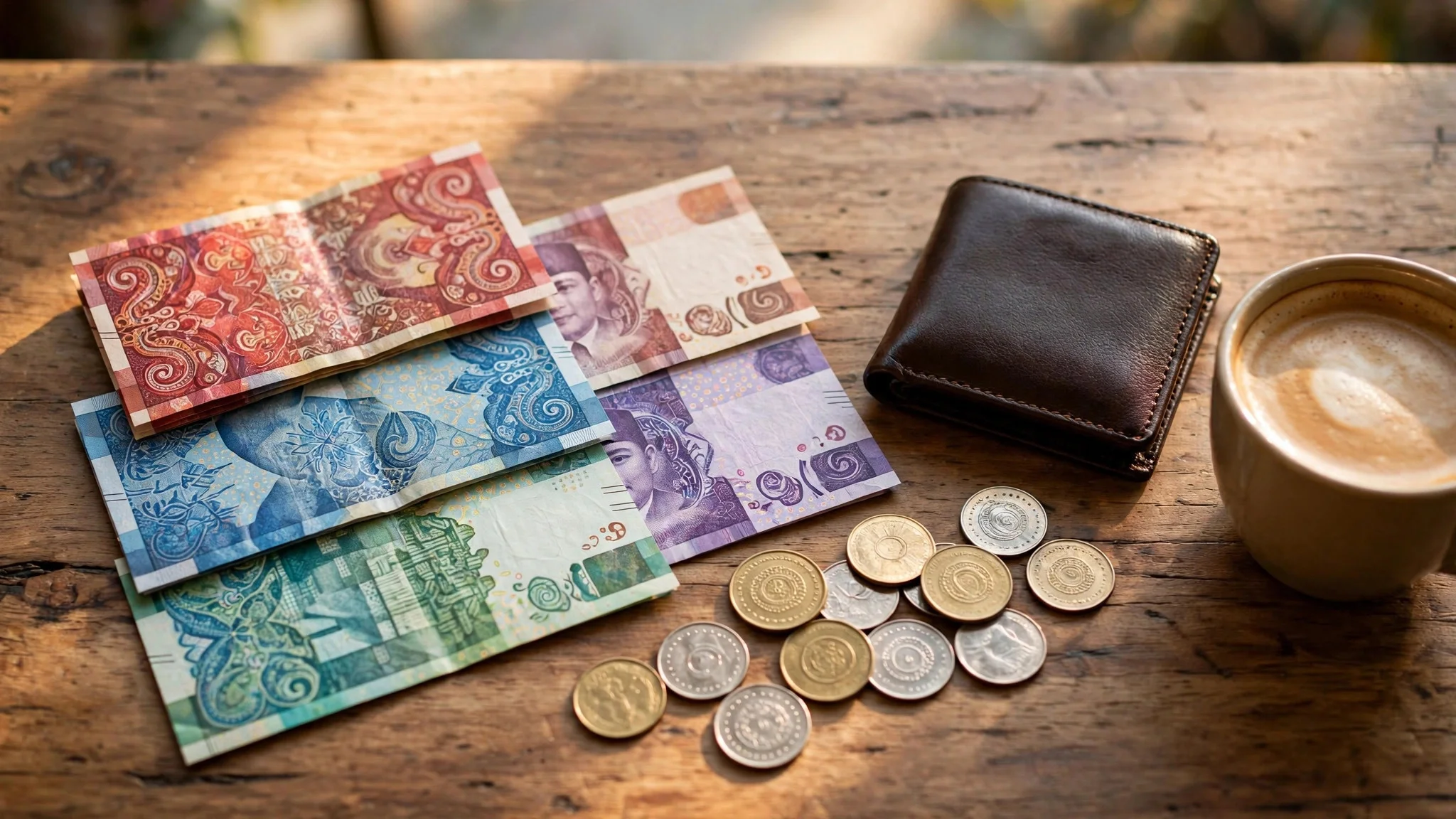
Tipping and bargaining work differently in Jakarta than in many countries. In short: tipping is never an obligation in Indonesia, a small tip is always appreciated, and bargaining is expected in traditional markets but not in malls or restaurants. This guide explains the details, with amounts in rupiah and dollars.
Keep small notes in your wallet, check every bill before you pay, and remember that a smile matters as much as the money.
Tipping in Jakarta: The General Rule
Indonesia has no strong tipping culture, and nobody will chase you for a tip. Many restaurants and hotels already add a service charge of 5 to 10 percent plus tax to the bill. If no service charge appears, a tip of 5 to 10 percent is generous, and rounding up to the nearest IDR 10,000 (roughly USD 0.60) is perfectly polite.
Keep IDR 10,000 and IDR 20,000 notes (roughly USD 0.60 and USD 1.20) separate, so you can tip without asking a waiter to break a big bill. Hand the tip directly to the person who helped you, and say "terima kasih" (thank you) in Indonesian.
Restaurants, Cafes, and Street Food
In restaurants, always check the bill for "service" and "tax". If a service charge is already included, you need not add anything, though leaving the small change is kind. If there is no service charge, leave around 5 to 10 percent, or IDR 20,000 to IDR 50,000 (roughly USD 1.20 to USD 3) at a mid-range restaurant. At a fine dining restaurant, IDR 50,000 to IDR 100,000 (roughly USD 3 to USD 6) is generous.
At street food stalls and small warung eateries, tipping is not expected at all. Prices are already low, often IDR 10,000 to IDR 30,000 per dish (roughly USD 0.60 to USD 1.80), so paying the exact amount is enough. In cafes, the tip jar on the counter is optional. Never feel pressured to tip; a friendly thank you is worth more than a forced tip.
Hotels, Drivers, and Tour Guides
In hotels, IDR 10,000 to IDR 20,000 per bag (roughly USD 0.60 to USD 1.20) for the bellhop is standard, and the same amount per day left on the bedside table is a thoughtful tip for housekeeping. At reception, no tip is needed. If a concierge arranges something special, IDR 20,000 to IDR 50,000 shows your thanks.
For drivers, tip IDR 20,000 to IDR 50,000 (roughly USD 1.20 to USD 3) for a half-day trip, more for a full day. Ride-hailing apps let you add a tip inside the app, which is the easiest option in the city. For a private tour guide, IDR 50,000 to IDR 100,000 per day (roughly USD 3 to USD 6) is fair, handed over with thanks at the end of the tour.
Bargaining in Markets: How to Do It Politely
Bargaining is part of the fun in traditional markets, textile shops, and souvenir stalls, but not in malls, supermarkets, or restaurants, where prices are fixed. In a market, the first price is an opening offer, and a fair final price often lands at 50 to 60 percent of it. Offer a little below your target price, smile, and stay friendly.
If the seller will not move, thank them and walk away slowly; they will often call you back with a better price. Never agree on a price and then refuse to pay it, and do not bargain hard over a tiny amount: IDR 5,000 (roughly USD 0.30) means little to a tourist and a lot to a small seller. Before a service such as a boat ride or a guided walk, always agree on the price first.
Cash, Cards, and Paying Smoothly
Cash in rupiah is still king in markets, street food stalls, and small shops, so carry a mix of notes every day. ATMs are easy to find in malls and on main streets, mostly dispensing IDR 50,000 or IDR 100,000 notes, with a typical limit of IDR 1,000,000 to IDR 2,500,000 per withdrawal (roughly USD 60 to USD 150). Tell your bank you are travelling before you leave home, so your card is not blocked, and use ATMs inside banks or malls.
Cards are widely accepted in hotels, malls, and mid-range restaurants; Visa and Mastercard work best, American Express less so. Mobile payments and QR codes are common, but most need an Indonesian app or local account, so visitors should rely on cash and cards. Exchange money at banks or licensed money changers, and keep the receipt: your passport may be needed for larger exchanges. When you pay, count the change before you walk away, and keep small notes ready for taxis and market stalls.
Ready to rent? Visit desasewaindonesia.com






