Power Plugs & Charging Guide for Tourists in Indonesia
Nothing kills travel momentum like a dead phone in an unfamiliar city. Before you land in Indonesia, it pays to know exactly how the country's power system works — which plug shapes fit, which voltage your devices will meet, and where you can top up on the go. This practical guide covers everything a first-time visitor needs to keep every gadget charged, from Jakarta to Bali.
Indonesia's Plug Type and Voltage
Indonesia uses Type C and Type F plugs — the two round-pin "Europlug" style common across continental Europe — running at 220–230 volts and 50 Hz. If you are arriving from most of Europe, your plugs will fit straight into Indonesian sockets with no adapter. Visitors from the UK, the US, Australia, Japan, and China will need a plug adapter: the pin shape is the problem, not the voltage, for most modern chargers. Nearly all phone, laptop, and camera chargers made in the last decade are dual-voltage (look for "100–240V" on the label), so they handle 220V safely with just a shape adapter.

A European-style two-pin plug adapter — the type that fits Indonesian sockets — photo: Pexels
Where You'll Find Power (and Where You Won't)
Hotels and guesthouses always have wall sockets, though budget rooms may offer just one or two — bring a small multi-plug if you travel with several devices. Cafes in Jakarta increasingly offer outlets for laptop workers, but it is polite to buy something first, and not every table sits near a socket. Soekarno-Hatta Airport has charging stations in the terminals, and executive trains on Java routes provide power outlets at seats. On boats, in rural homestays, and at beach clubs, assume there is no convenient charging — top up before you head out.
Adapters, Power Banks, and What to Buy Locally
Forgot your adapter? Universal travel adapters are sold everywhere — airport shops, malls, and minimarkets like Indomaret and Alfamart — from around Rp75,000 (about $4.70). A power bank is the single most useful travel accessory in Indonesia: long days of maps, ride-hailing, and photos drain batteries fast, and a 10,000 mAh bank (from around Rp200,000 or $12.50) covers a full day. Buy from reputable brands at malls rather than street stalls, where counterfeit batteries are common. Carry a short spare cable too — cables fray faster in tropical humidity, and hotel gift shops charge a premium for replacements.

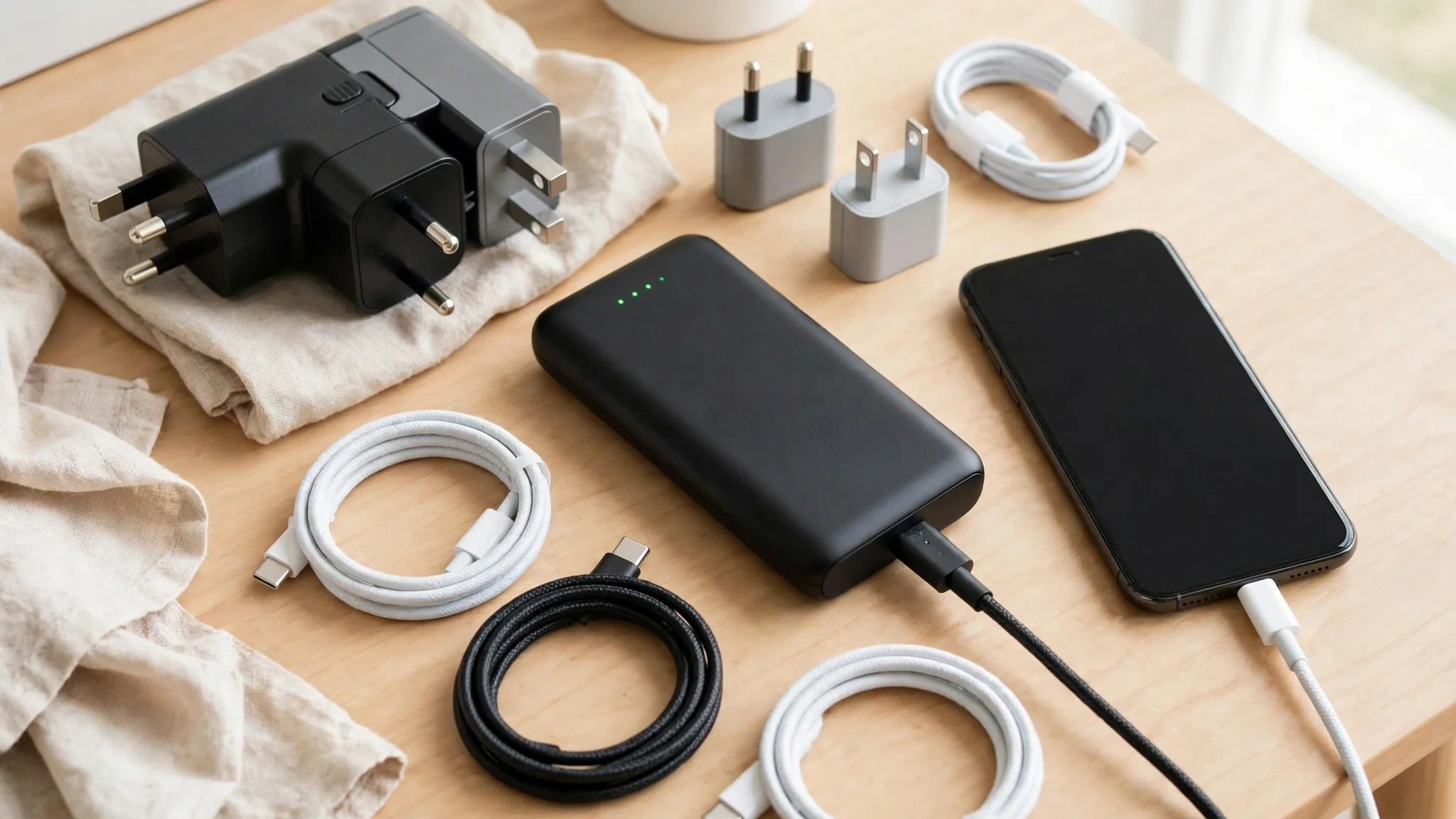
Travel charging gear: plug adapters, a USB wall charger, a USB-C cable and a power bank — photo: Pexels
Charging Safety Tips
Stick to branded chargers and avoid suspiciously cheap no-name adapters — faulty chargers are a genuine fire risk. If you are coming from a 110V country such as the US or Japan, check heat-styling tools and other high-wattage appliances: unlike phone chargers, many hair dryers and straighteners are single-voltage and can burn out on 220V unless they have a voltage switch. During the rainy season, brief power flickers happen; unplug sensitive gear during storms, and never leave charging devices unattended on soft bedding.
Stay Powered and Connected
Keeping devices charged is only half the battle — you also need them online. A pocket WiFi device (around Rp50,000–Rp80,000 or $3–$5 per day) gives you reliable internet for maps, ride-hailing, and translation without hunting for a SIM card. If your phone is locked to your home carrier, rent a smartphone locally; digital nomads can even rent a laptop instead of flying with expensive gear. Foreign renters generally just need a passport as ID, with delivery available to hotels across Jakarta or pickup at Soekarno-Hatta Airport.
Ready to rent? Visit desasewaindonesia.com
Don't let a dead battery or a missing SIM slow your trip — rent pocket WiFi, a smartphone, or a laptop and stay powered from landing to takeoff. Ready to rent? Visit desasewaindonesia.com for tourist-friendly rentals delivered to your hotel or the airport.